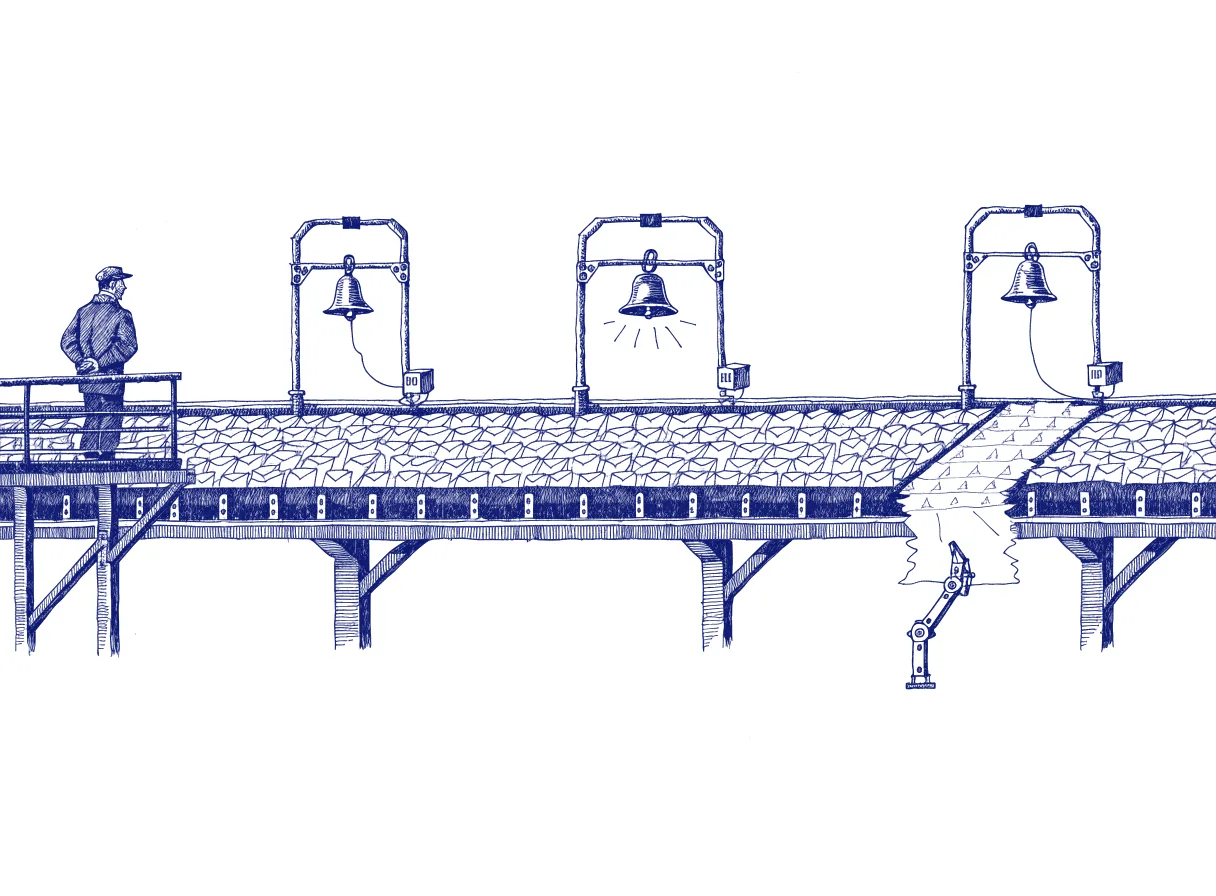
Engineers are shipping faster, so we made our CI self-driving to keep up
Raúl Negrón-Otero · 28 October 2026
Read the originalPostHog's developer experience team let AI agents fix its code pipeline only where three fixed queries flag a problem, after merged pull requests rose almost fivefold.
PostHog, which makes product analytics and developer tools, merged more than 6,500 pull requests in October 2026, against 1,354 a year earlier. Raúl Negrón-Otero of its developer experience team describes how the team copied its build data into an internal tool that AI agents can query. Three fixed queries now decide which problems the agents investigate and try to fix.
- In October 2026, 11% of PostHog's merged pull requests were opened by its own scheduled AI agents after finding something worth acting on in product data.
- The internal tool treats each pull request as a user and each step towards production as an event. AI agents query it directly instead of calling GitHub.
- The fixed queries flag a check that fails and then passes on the same commit, a failing main branch, and a workflow that has become slower.
- The agents fixed a test job that failed on every push and a Rust test job with two competing tests. They also cut one check from 51 seconds to 33.
An engineering team that lets AI agents maintain its build system can keep them focused by writing down, in advance, which problems they may act on. This is PostHog's account of a practice built on products it sells.
Copy build and test run data into a database that AI agents can query, instead of having agents call the code host for every question.
Let AI agents work on the build pipeline only when one of a few fixed queries flags a problem, such as a flaky check, a failing main branch or a slower workflow.
Derived by Working Surface from the article; more in the Playbook. Source line: Finding the right signal-to-noise ratio requires some experimentation and a bit of prompt massaging.
29 October 2026: as AI agents raise the volume of work to check, teams move the check closer to the work: fixed rules for what agents may fix, design rules written where agents read them, reviewers trained on how AI-written code goes wrong, and leaders who do the work and are reviewed in public.