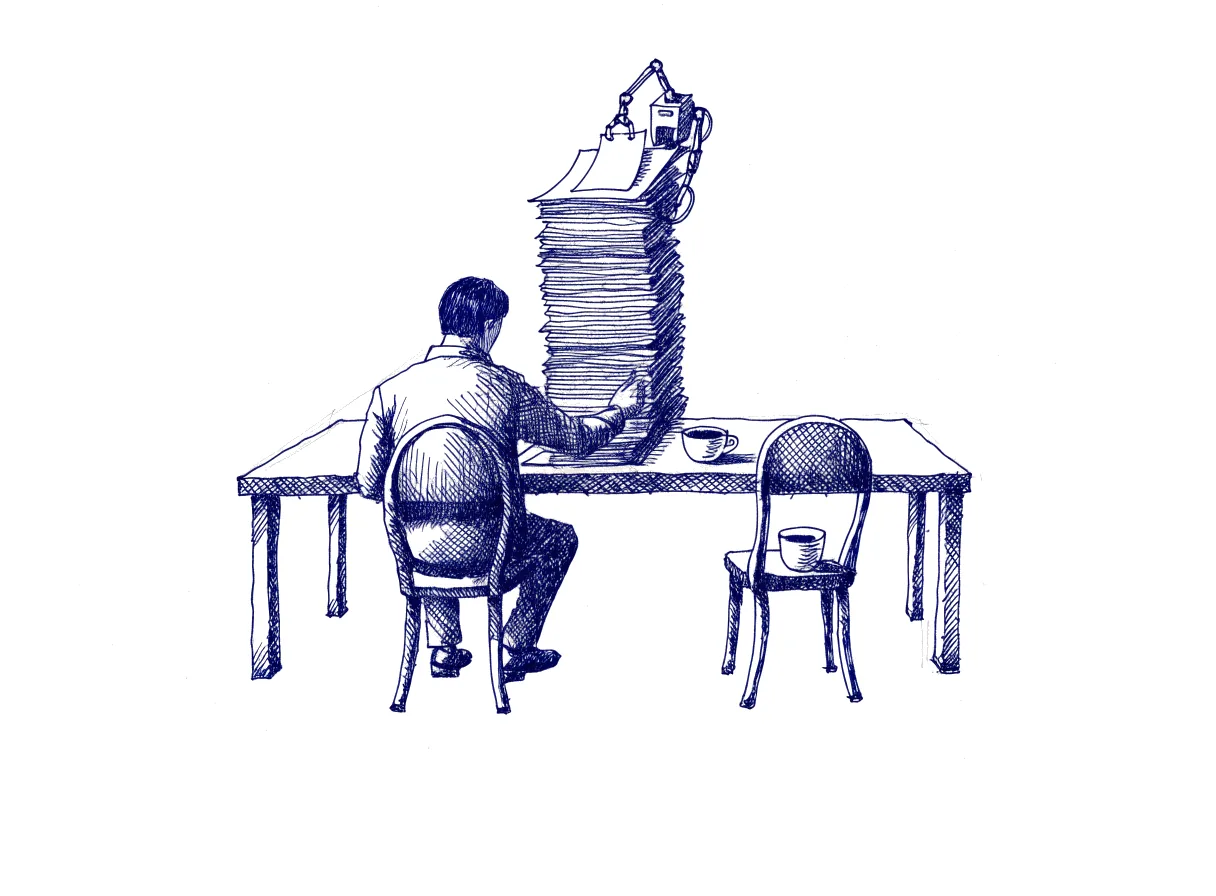
Where do we find room to think?
Maya Elise Joseph-Goteiner · 27 September 2026
Read the originalMaya Elise Joseph-Goteiner, founder of the user-experience agency Velocity Ave, worries that research teams increasingly edit AI output, which cannot push back as a colleague would.
Maya Elise Joseph-Goteiner founded Velocity Ave, a user-experience agency, and co-wrote the book UX Skills for Business Strategy. In her newsletter Nimble UX, she observes that research teams increasingly direct and edit what AI tools produce, instead of creating the work themselves. She argues that editing AI output differs from editing a colleague's work, because no author stands behind it to explain an intention or push back.
- In a study by researchers at Microsoft and Carnegie Mellon, knowledge workers described a shift from doing parts of their work to checking what AI produced. Joseph-Goteiner notes that the study does not show whether people's ability to think is declining.
- One leader interviewed by her firm raised the idea of a research team of one person working with a team of AI agents. She says such a team would lose the colleague who disagrees, catches what was missed or helps find the words for an idea.
- She says that when a company mandates AI without deciding how it will be used, staff can feel they must perform enthusiasm or look opposed to progress.
- She finds it odd that many gatherings for researchers are hosted by companies building AI research products, and asks which conversations become harder there.
A team that drafts research with AI can make sure a second researcher works through each set of findings, so that someone can disagree with the interpretation. This is an inference and is not the author's claim; her essay mostly raises questions.
When AI tools draft research findings, have a second researcher work through the interpretation with the first, so that someone can disagree and catch what was missed.
Before requiring a team to use an AI tool, agree in writing which tasks it is for, so that nobody feels they must fake enthusiasm for it.
Derived by Working Surface from the article. Source line: We learn to think by working through ideas with other people.
29 September 2026: when AI tools do the making, a team has to keep some of the old steps on purpose.