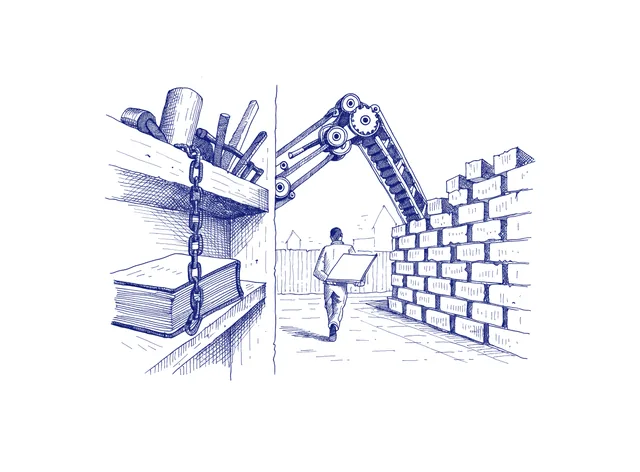


AI agents now make prototypes, design tools and code cheaply, so the scarce work is a person's judgement and a person's name on the result. Seven pieces from 16 to 19 November show this in hiring, design, IT administration, written instructions for AI agents and the path from idea to production.
Jaclyn Konzelmann (20 Nov · 01), a product director at Google Labs, has changed what she looks for when she hires product managers. Earlier in 2026 she rewarded candidates who arrived with a working prototype. Now that anyone can build one, she treats a prototype as the start of her questions. She asks who it is for, what was left out, whether the core loop holds and why a user would return. She gave the same fitness-app request to three AI tools, and all six results looked alike.
Luke Wroblewski (20 Nov · 02), a product designer and author, describes designers building their own small design tools with AI coding agents. He calls such a tool a playground: a page with controls that show a design's variants, states and timing on real content. Playgrounds used to cost more to build than they returned, so designers kept to static mockups. With coding agents, a designer can build one for a single question and discard it afterwards. He built one to test how much of an AI agent's activity an app should show.
Microsoft Digital (20 Nov · 03), Microsoft's internal IT organisation, reports on rolling out Autopilot, an always-on personal AI agent, to its own staff. Each Autopilot has its own sign-in identity, mailbox and storage, and lists its employee sponsor as its manager. It starts with access to nothing, and each resource is granted as a new team member's would be. Ramanan Hariharan, a principal engineering manager, said: "Every agent user needs to be accountable to a human."
AutonomyAI (20 Nov · 04), a company that sells AI product delivery tools, reviewed 326 sales calls with buyers at 131 business software companies. Product leaders described slow handoffs, while engineering leaders described review they could no longer keep up with. Prototypes built beside the real codebase were rebuilt by engineers. The company's marketing lead, Guy Leshno, concludes that the real measure is changes that reach production. He advises writing down who may open and review a pull request before adding tools.
Supernova (20 Nov · 05), which sells design system software, read the AI agent instruction files in 30 public design system repositories. Sixteen repositories had one, and all sixteen were written for people who contribute to the design system. Product teams that build with those systems, and the AI agents they use, never open these files. Nezar Mansour, the author, offers a short section for a product team's own repository. It names the component package, bans hard-coded values and tells the AI agent to stop and ask when nothing fits.
Product Map (20 Nov · 06), which sells AI agents for product managers, published a guide to five tasks a product manager can now run alone. They include rehearsal interviews with AI personas and a prototype built in an afternoon. The guide says to write the specification after three users have tried the prototype, starting with what to keep and what to cut. It cites a Product Focus survey in which 97% of frequent AI users reported higher productivity and 64% reported better product outcomes. Its answer is to end every task in a written decision.
NerdHeadz (20 Nov · 07), a software agency, writes about companies whose staff build AI agents faster than anyone tracks them. It argues that most of these agents are tried and abandoned, and need little oversight. A few become something a team or a customer relies on, and nobody announces that change. The agency proposes a register that records each such agent's owner, permissions and fallback, reviewed once a month.
In each case, what an AI agent produces is now plentiful, and the value lies in the decision behind it. A hiring manager probes the choices behind a prototype, and Microsoft ties every agent to a human sponsor. Engineering leaders accept only changes that someone can stand behind. Supernova, Product Map and NerdHeadz describe where that decision is written down: a repository's instruction file, a decision log and a register of AI agents.
Five of the seven accounts come from companies describing their own products or services, and Konzelmann writes about interviews rather than shipped work. The pattern may say more about what these authors sell or value than about how most teams work.
Jaclyn Konzelmann, a product director at Google Labs, no longer counts a working prototype as proof when hiring product managers, because AI makes generic ones easy to build.
Luke Wroblewski, a product designer, argues that AI coding agents let designers build small, disposable design tools for single questions, replacing static mockups for many decisions.
Microsoft's internal IT organisation gives each employee's always-on AI agent its own identity, a named human sponsor and no access until someone grants it.
AutonomyAI's review of sales calls with 131 software companies found that AI made code cheap, while engineering review of non-engineers' changes became the constraint.
Supernova, which sells design system software, checked 30 public design system repositories and found no AI agent instruction file written for the product teams that use those systems.
Product Map, which sells AI agents for product managers, advises them to build the prototype first, write the specification from it, and end each AI-assisted task in a written decision.
NerdHeadz, a software agency, argues that most AI agents staff build need little oversight, and that the few a business comes to depend on need a named owner.