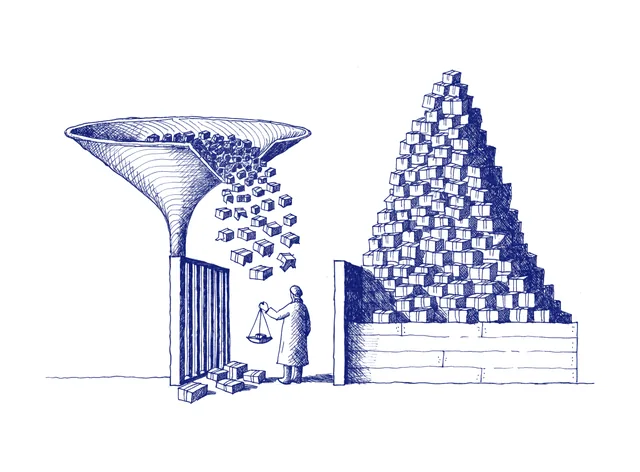
Five pieces, four of them published on 2 November, move the human check on AI-assisted work to an earlier point. They review the plan, the shared instructions or the rules that an AI agent follows, or they name in advance the person who answers for the result.
The head of development at a business software company, who writes as tanashun (3 Nov · 01), described in Japanese how the team reviews code from Claude Code, Anthropic's AI coding agent. Pull requests were arriving faster than anyone could read them, and design mistakes found in code review meant rewriting much of the code. The team now has a person read the AI agent's plan before any code exists, checking the requirements, the code it will touch and the shape of data and interfaces. AI reviews then check that the code follows the approved plan. In code review, the person looks mainly for changes that nobody asked for.
Ezra Mechaber, a growth product manager at the design software company Figma, described its product managers' AI setup to Claire Vo on the podcast "How I AI" (3 Nov · 02). Mechaber is one of the creators of PM OS, a shared Git repository of 31 AI skills, an AGENTS.md instruction file and a few command hooks. A version check keeps 60 to 70 product managers on the same setup, and one skill adds the right designer and engineering manager as reviewers. AutoXP, a set of three AI agents, finds where users drop out of a growth funnel, proposes new copy and prepares the code. A person reviews each experiment once before it launches.
Pekka Oskari Puhakka, a design consultant, wrote in UX Collective about merging a client's separate design kits into one company-wide Figma library, work that began in 2022 (3 Nov · 03). A council of designers from each business unit made the decisions. The delivered kit held 1,786 component variants, including 260 versions of the button, of which only 15 needed real design decisions. Puhakka argues that a fixed kit stores decisions that go out of date, and that rules governed as an AI skill could keep a system current. Puhakka adds that a new project would be needed to prove it.
Ali Alkhafaji, chief executive of the customer experience firm Apply Digital, wrote in InformationWeek about client teams that are at least half AI agents (3 Nov · 04). When agents work in sequence, one agent's poor call can compound before any person sees the output. Alkhafaji requires one named person to answer for every output, and that person must be named before deployment starts. A record at each handoff between agents states what the agent was trying to do, what data it had, how confident it was and what it did.
A.Team, a company that supplies engineering teams to other companies, published a guide on what changes when every engineer runs AI coding agents (3 Nov · 05). It cites telemetry from Faros AI, an engineering analytics vendor, in which teams with high AI adoption merged 98 per cent more pull requests while review time rose 91 per cent. The guide advises one instruction file in each repository, a written review policy and a map that sets review depth by risk. It also says that whoever merges the code owns it, and that an AI agent's pull request needs an approver other than the engineer who asked for it.
In each account, people stop checking every output and decide earlier what the AI agent should do. The development head reviews a plan, Figma's product managers share one set of skills and one review before launch, and Puhakka proposes governing the rules themselves. Alkhafaji and the A.Team guide settle in advance who answers for the result. The human effort does not disappear: tanashun reports that it grew, but that stopping a wrong direction early costs less than rewriting code.
Four of the five are one person's account of their own practice, with no measured results, and Puhakka's proposal is untested. Apply Digital and A.Team both sell services to the companies they advise, and the guide itself says that the Faros figures are correlations. An AI agent can still depart from an approved plan, so a review that reads mainly the plan may miss problems that only appear in the code.
A development head at a business software company has a person review an AI agent's plan before code exists, so code review checks mainly for unrequested changes.
Ezra Mechaber, a product manager at the design software company Figma, helped build 31 shared AI skills that put 60 to 70 product managers on one working setup.
Design consultant Pekka Oskari Puhakka, recalling a Figma library of 1,786 variants, argues that rules governed as an AI skill could keep a design system current.
Ali Alkhafaji, chief executive of Apply Digital, requires one named person to answer for every output of the firm's AI agent teams, named before deployment starts.
A.Team, which supplies engineering teams, advises that an AI agent's pull request needs an approver other than the engineer who asked for it, because review breaks first.