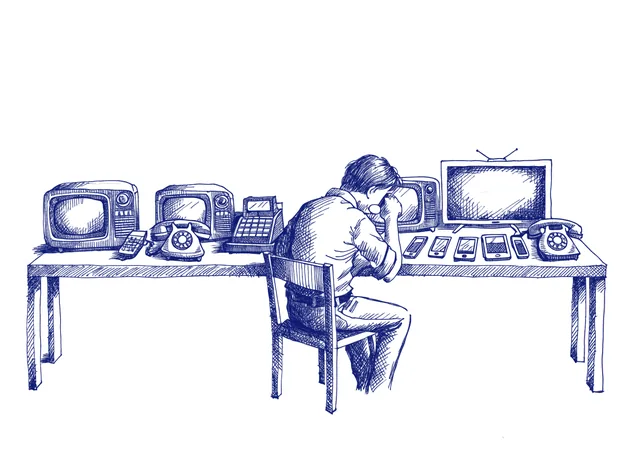
No team field report on working with AI agents appeared in the last 36 hours, so this issue takes up an open question with one essay from 9 October. The question is who writes down what a user can now finish with a product. It also asks whether that statement must exist before a team settles on a familiar form such as a chat box.
Luke Wroblewski (12 Oct · 01), a product designer who writes about interface design, set old and new designs side by side for televisions, phones, cars and planes. He wanted to test a complaint he had read for years, that design has become uniform. The first reason he lists is that design can step back once a product's purpose is clear, so a television becomes mostly picture. Others include price competition in mature markets and physical limits such as aerodynamics and airport layouts. He adds that software converges faster than hardware, and that apps are already being turned into chat interfaces only a few years after the release of ChatGPT, OpenAI's chat assistant.
Wroblewski's first explanation links a settled form to a settled purpose. This issue infers, and Wroblewski does not claim, that a team which adopts a chat interface before it has written down what the user can now finish reverses that order. This issue also infers that the person who demonstrates a build is the natural author of that statement. Someone else should then read it before the meeting where the build is shown.
Wroblewski describes how consumer products converged over decades, not how any team chooses an interface, so the essay cannot support a claim about team practice. Chat may also be the right form for many products, because users already know how to use it.
Luke Wroblewski compares decades of televisions, phones and cars to explain why designs converge, and notes that software apps are converging on chat far faster.